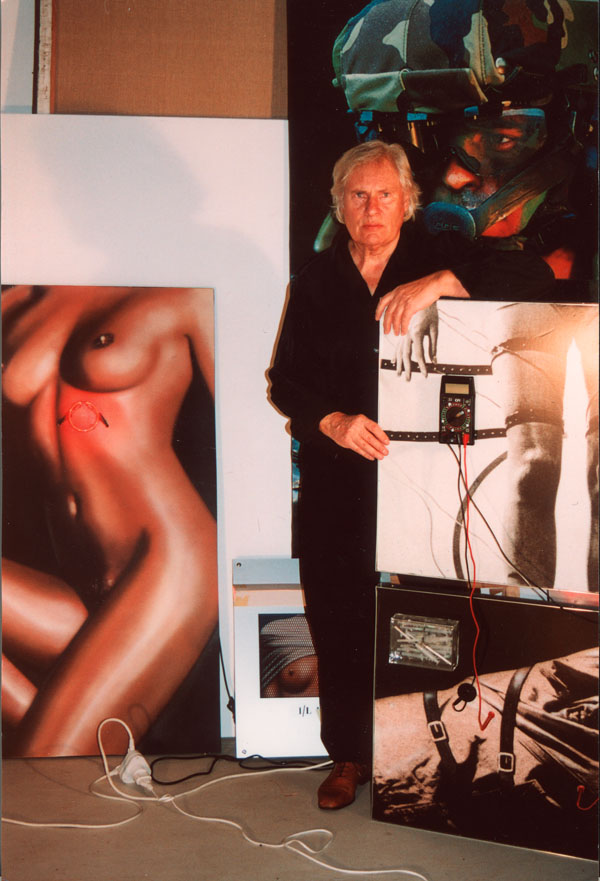
Artist Peter Klasen is a master of contrasts. Of fragment and entirety, of hard plate against soft skin. He is constantly finding new approaches. Fusing splinters of reality and dreams into a collage full of life. Clips from weeklies, bits of cardboard and parts of military planes and vehicles are but a few of the materials used in his constructs. In his paintings fateful darkness reveals its relationship to fertile light; shimmering blues and greens stand in counterpoise to greys and browns. Roughness against smoothness. Bits of rope and symbolic tongues of flames in stark contrast to supplicant hands stretched skywards. Naked female bodies, breasts and parted lips are mingled with numbers and symmetric colour fields.
As far back as 1962, along with figures such as Adami, Erró and Télémaque, Peter Klasen was one of the founding fathers of La Nouvelle Figuration, the new trend that brought the importance of figurative art into the spotlight. This direction developed almost at the same time as Pop Art picked up momentum in the US, with luminaries like Robert Indiana, Tom Wesselmann, Roy Lichtenstein and Andy Warhol to name but a few. Since his artistic debut at Galleri Friedrich in Munich in 1964 however, Klasen has evolved a truly individual imagery.
It would seem a paradox that Peter Klasen creates a balance between the sensual and the industrial, a cross-fertilisation between the agreeable and the disgusting, the tasteful and the abhorrent. But it is this very contradiction that more often than not is expressed in his pictures. In addition to paintings on linen canvas, iron, sheet metal and wood, he has created several public works including the decoration for part of the La Défense business district in Paris.
Peter Klasen was born in Lübeck in 1935. He began to draw and paint even as a child, encouraged in these first artistic strivings by his grandfather, an art and antiques dealer. His time at the Berlin Academy of Arts in post-war Germany proved a turning point as he was inspired to begin painting in an avant-garde style. Around the same time he met Georg Bazelitz, known for his Neo-Impressionistic works. In the early 1960s, Klasen moved to Paris. His first years were tough – poverty and the lack of an understanding audience plagued him. His breakthrough was not to come until the 1970s. He had his first exhibition in Sweden in 1988 at Galleri GKM Siwert Bergström in Malmö.
Exhibitions have been staged in Frankfurt, Milan, Los Angeles and Barcelona to celebrate Peter Klasen’s 70th birthday. This coming autumn some of his works can be seen at La Maison Européenne de la Photographie in Paris.
The art expert Gilles Plazy has written an incisive analysis of his work, at one point saying that several of his pictures represent a partition, a mental Berlin wall – the image of a divided Germany many still carry within. It is true, but at the same time it must be stressed that Klasen’s wall also provides a portal. He opens a door towards remembering and to the ambiguous regions of the subconscious.
Johan Persson, 14 March 2005