César Baldaccini (1921–1998) is one of the great sculptors of the twentieth century. As a young man he took a stand for art that was firmly anchored in reality, as a counterweight to the lyrical, abstract painting of the time. He has transformed rusty bolts, screws, scrap metal and steel wire into biomorphic sculptures depicting everything from chickens on roller skates to self-portraits of the artist. In his magical hands, metal from the junk-heap, old car parts, discarded cans and plexiglass have been compacted into delightful cubistic works of art that César himself has called “compressions”. As a kind of antithesis to these, he experimented by expanding plastics, glass, aluminium and bronze into voluptuously inflated forms known as “expansions”.
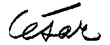
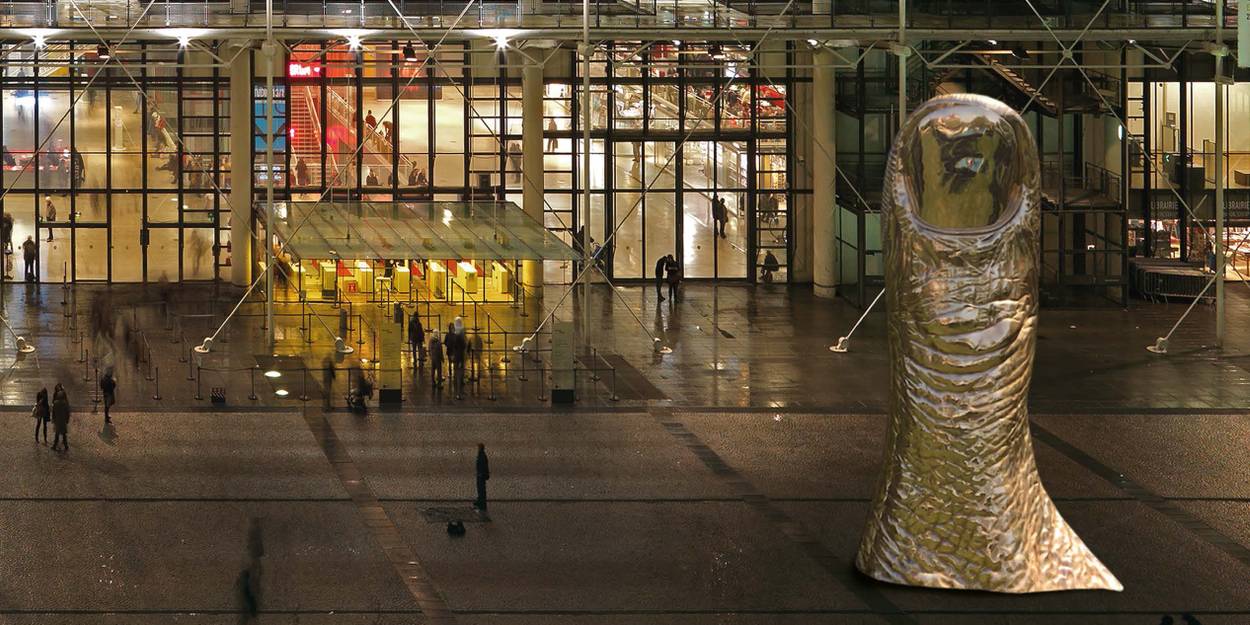
Among César’s casts of sculpted breasts, female torsos and clenched fists, it is the thumb that, above all else, has emerged as the artist’s hallmark – his own, greatly enlarged thumb in bronze. Exhibited for the first time at the Galerie Claude Bernard in Paris in 1965, today you can see it – in bronze or marble – in museums and public places all over the world. His largest bronze thumb, measuring fully 12 metres in height, stands in La Défense in Paris. In similar fashion, the artist’s signature is always accompanied by his thumb print.
Born in Marseilles in 1921, by the age of 12 César had already left school to work in his father’s wine merchants business. In 1935, however, he enrolled at the École des Beaux Arts in Marseilles. He continued his art studies in 1943 at the École Nationale Supérieure des Beaux Arts in Paris, sharing a house for some time with Alberto Giacometti. In 1960 he was invited to join the group of artists known as “les Nouveaux Réalistes”, where he worked together with Arman, Pierre Restany, Niki de Saint Phalle, Jean Tinguely and others.
César’s genius lies in his ability to coax artistic forms from whatever materials may be at hand. “When I was a child,” he recalled, “I used to think that a sculptor was a man who chipped away at stone with a hammer and chisel. It was only later that I understood you can make sculptures from any material you choose.” In the early 1940s César discovered the opportunities that scrap metal opened up, and his first solo exhibition, “Animaux en ferraille” (or “Scrap metal animals”), was held at the Galerie Lucien Durand in Paris in 1954. “I don’t choose my materials to suit a particular motif,” he once said. “It’s the material itself that shapes the expression I give to my sculptures.”
The collaboration between GKM and César started already in the early 1980’s as Siwert Bergström met with César at FIAC. The meeting led to the exhibition of some works by César at FIAC and at Stockholm Art Fair. In 1988, Siwert got the idea to invite César to make a compression of a Volvo car in Malmö. César was excited about the idea and the happening was a great success. This was the first one man show at GKM in Malmö. The collaboration continued until César’s passing in 1998 and resulted in some more exhibitions as well as editions of graphics and a multiple.
César Baldaccini (1921–1998) är en av 1900-talets store skulptörer. Som ung tog han ställning för konst i direkt förankring med verkligheten som motvikt till den tidens lyriska och abstrakta måleri. Han har omvandlat muttrar, skruvar, skrot och ståltråd till levande skulpturer i olika gestalter; allt från kycklingar på rullskridskor till självporträtt. Järnskrot, gamla bildelar, läskburkar och plexiglas har han pressat samman till vackra kubistiska konstverk - kompressioner. Som en slags antites till dessa lät han plaster, glas, aluminium och brons expandera till mjuka svulstiga former - expansioner.
Bland Césars gjutna skulpturer återfinns både bröst, kvinnotorsos och knytnävar, men det är framför allt tummen som har blivit hans signum – hans egen tumme förstorad i brons. Den visades för första gången på en utställning på Galerie Claude Bernard i Paris 1965 och finns att beskåda i brons eller marmor på muséer och i offentliga miljöer runt om i världen. Hans största bronstumme,12m hög, står i La Défense i Paris. Likaså åtföljs alltid hans signatur med hans tumavtryck.
César föddes 1921 i Marseille och vid 12 års ålder slutade han skolan för att arbeta med sin far som var vinhandlare. 1935 började han på École des Beaux Arts i Marseille och fortsatte 1943 sina konststudier på École Nationale Supérieure des Beaux Arts i Paris där han bodde i samma hus som Alberto Giacometti. 1960 blev han inbjuden att ansluta sig till konstnärsgruppen les Nouveaux Réalistes, där han verkade tillsammans med Arman, Pierre Restany, Niki de Saint Phalle, Jean Tinguely m.fl
Césars genialitet ligger i att han skapade utifrån det material som fanns tillgängligt. ”Som barn trodde jag att en skulptör var en man som bearbetade sten med hammare och mejsel. Senare förstod jag att man kunde göra skulpturer av vilket material som helst”. I början av 1940 talet upptäckte han järnskrotets möjligheter och hans första egna utställning hette ”Animaux en ferraille” (järnskrotsdjur) och hölls på Galerie Lucien Durand i Paris 1954. ”Jag väljer inte material för att det skall passa till ett speciellt motiv utan det är materialet i sig som leder mig till skulpturens utformning.”
Samarbetet mellan GKM och César tog fart i början av 1980-talet när Siwert Bergström mötte César på FIAC I Paris. Till en början ställde GKM ut några verk på FIAC och på Stockholm Art Fair. 1988 fick Siwert idén att bjuda in César att göra en kompression av en Volvo på en bilskrot i Malmö. Céasar gillade idén och happeningen blev en succé. Samarbetet fortsatte fram till Césars död 1988 och resulterade i flera utställningar liksom i editioner av grafiska blad och en multipel.
César Baldaccini (1921–1998) est l’un des plus grands sculpteurs du vingtième siècle. Dès sa jeunesse, il s’est fait le défenseur d’un art ancré directement dans la réalité, par opposition à la peinture abstraite et lyrique qui régnait à l’époque.
Il s’est employé à transformer des écrous, des vis, de la ferraille et des fils de fer en des sculptures vivantes sous divers aspects : depuis des poulets chaussés de patins à roulettes jusqu’à des autoportraits. Il a comprimé de la ferraille, de vieilles carcasses de voitures, des canettes de bière et des objets en plexiglas pour en faire de belles oeuvres cubistes – des compressions. En guise d’antithèse à celles-ci, il a converti par dilatation des objets en plastique, en verre, en aluminium et en bronze, en des formes douces et boursouflées - des expansions.
Parmi les sculptures fondues de César, on trouve des seins, des torses de femme et des poings serrés, mais c’est avant tout le pouce qui est devenu son emblème – son propre pouce agrandi aux proportions du bronze. Ce pouce a été exposé pour la première fois à la Galerie Claude Bernard, à Paris, en 1965, et on peut maintenant l’admirer, reproduit en bronze ou en marbre, dans des musées ou des places publiques du monde entier. Son plus grand pouce en bronze, qui mesure 12 m de haut, se trouve place de la Défense à Paris. De même sa signature est toujours accompagnée de l’empreinte de son pouce.
César est né en 1921 à Marseille. Il a quitté l’école à l’âge de 12 ans pour travailler avec son père, un négociant en vins. En 1935 il est entré à l’École des Beaux Arts de Marseille, et a poursuivi en 1943 ses études à l’École Nationale Supérieure des Beaux Arts à Paris, où il habitait la même maison qu’Alberto Giacometti. En 1960 il fut invité à adhérer au groupe d’artistes les Nouveaux Réalistes, où il a travaillé conjointement avec Arman, Pierre Restany, Niki de Saint Phalle, Jean Tinguely, etc.
L’originalité de César est d’avoir travaillé à partir de matériaux disponibles. “Enfant, je croyais qu’un sculpteur était un homme qui taillait la pierre avec un ciseau et un marteau. J’ai compris plus tard qu’on pouvait créer des sculptures avec n’importe quel matériau. ” Au début des années 1940 il a découvert les possibilités de la ferraille, et sa première exposition personnelle, intitulée “Animaux en ferraille”, eut lieu à la Galerie Lucien Durand, à Paris, en 1954. ”Je ne choisis pas un matériau en fonction du sujet de ma sculpture, mais c’est le matériau qui me conduit au sujet.”
La collaboration entre GKM et César a commencé déjà au début des années 1980 quand Siwert Bergström a rencontré César à la FIAC. Au début GKM a exposé quelques oeuvres de César à la FIAC et à Stockholm Art Fair. En 1988, Siwert a eu l’idée d’inviter César à faire une compréssion d’une voiture Volvo à Malmö. L’idée a beaucoup plu à César et le happening a été un grand succès. Cela fut le premier one man show à GKM à Malmö. La collaboration continuait jusqu’à la mort de César en 1998 et aboutissait à des autres expositions ainsi qu’à des éditions de graphique et d’un multiple.